With Walt Whitman in Camden: A Digital Edition
Encoding Guidelines
Traubel Tags
Click on sample pages to view a larger version
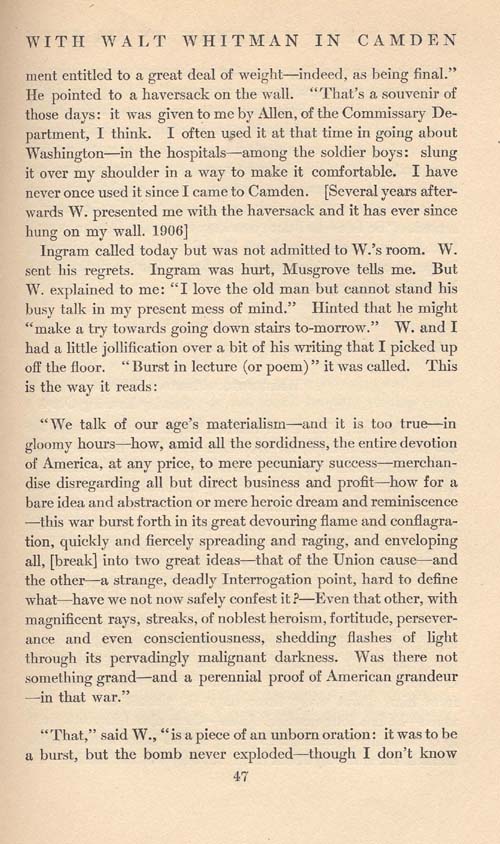
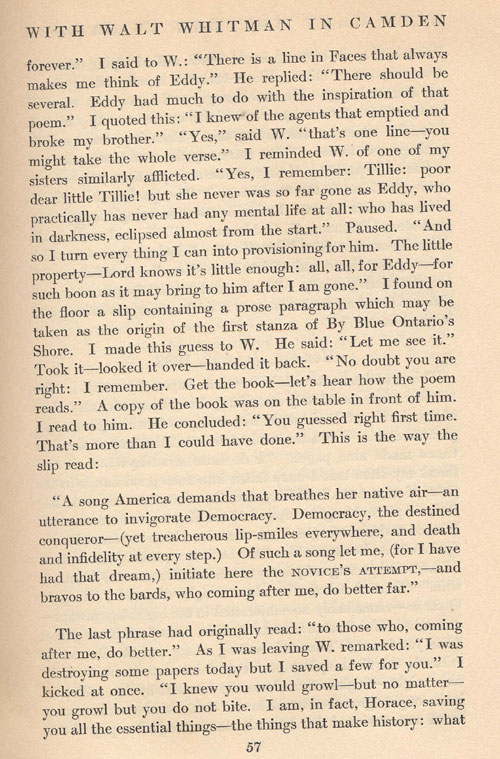
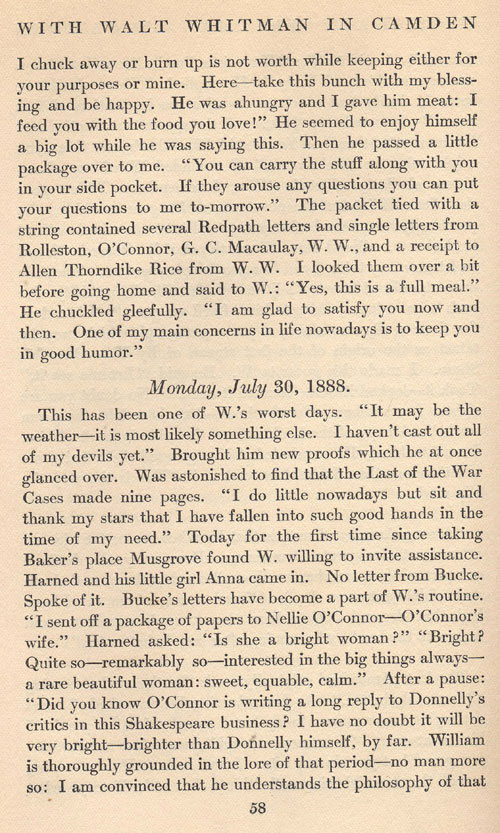
"Spoken" Quotations
The first set of tags represent the most frequently quoted "characters" in WWiC. Using any of these will place the cursor in between the tags: <q who="Walt Whitman"></q>. Or, you can choose to open and close the tags separately. Feel free to make a new quotation tag for any frequent speaker you come across - remember to keep a log of any speaker that come across, in the form that you have used their name (i.e. indicate whether you used T. Harned, Tom Harned, Thomas Harned, etc. so that we can come up with a standard for each name)
Use "Ambiguous" when you're not sure which speaker in a conversation to attribute the quotation to. When the gang is Harned's consuming wine and spouting politics, sometimes it can be difficult to track who is speaking.
Use "Unknown" when the speaker is an unnamed figure; for example, "a printer", "someone on the street", "a child", etc.
Written Quotations
"Written" (<q who="" type="written"></q>) can be used for any quoted material that is described as written; for example, Traubel often refers to a line of text that is written on the back of a letter in Whitman's hand. The cursor will appear in between the quotation marks following who= so that you can fill in the author.
Some written quotations represent a fragment of Whitman's work (or, in some cases, the work of someone else). In these cases, use one of the "Extract" tags.
For Prose (such as the "unborn oration" on the right):
<q who="Walt Whitman">
<text type="extract">
<body>
<div1 type="prose"><p>"We talk of our ages....war."</p>
</div1>
</body>
</text>
</q>
Be sure to incude <p> tags as necessary.
For Poetry:
<q who="Walt Whitman">
<text type="extract">
<body>
<lg1 type="poem">
</lg1>
</body>
</text>
</q>
In both cases, the cursor will appear where the body of the extract should be transcribed. For prose, enclose the text in <p> tags as necessary. Poetry is more complex, (see an example here), and rare enough so that it doesn't have a place in the library—we'll deal with them on a case-by-case basis. The tags are set for "Walt Whitman," but occasionally, you may need to use these tags for someone else's work; in these cases you can just replace Whitman's name with the author's. "Extract" serves an important function in situating this text relative to the archive as a whole; it will allow us to pull these fragments and relate them to Whitman's work as it is represented in the archive. So, if anything seems to be a "work" (which we have already established as a problematic term) or a piece of a work by Whitman, be sure to mark it as an extract so we can discuss it.